What is programmatic advertising?
Programmatic advertising means the automated buying and selling of advertising space through technology platforms. The buyer sets objectives, a budget and delivery criteria; the tools execute transactions and select eligible opportunities. Buying may take place through auctions or at an agreed price, with or without reserved inventory.
Programmatic is a buying method, not an advertising format or a specific type of targeting. It can be used to deliver banners, video, native advertising, audio, CTV or DOOH (digital out-of-home). The technical processes vary by channel.
This guide focuses on the open web and the mechanisms encountered by publishers, agencies and advertisers in the French market. The detailed diagram uses a website as its example: it should not be applied unchanged to connected television.
For an institutional definition: programmatic advertising, CNIL.
An ad impression in practice
Consider a fictional example: a brand wants to run video ads on French travel websites. It sets a budget, a campaign period, quality criteria and a frequency cap suited to the campaign where technically available.
- A user opens a page. An ad placement becomes available, identified in the chain by a Placement ID depending on the configuration. Consent choices and the browsing context determine which signals may be used.
- The publisher calls on demand. Its selling partners pass on an opportunity: placement, format, domain, floor price and available signals.
- DSPs evaluate the opportunity. Each platform checks eligible campaigns, their budgets and rules, then decides whether to respond.
- Bids compete. The platforms and publisher ad server apply their eligibility rules, priorities and commitments.
- The selected ad is loaded. Delivery events are measured: impression, viewability, video playback or conversion, depending on the tools and permissions.
Winning an auction does not yet mean an ad has been seen. Between the decision and actual exposure, loading may fail, the user may leave the page or the placement may remain off-screen.
The diagram everyone knows
If you are familiar with programmatic, you have almost certainly seen this representation: a publisher, an SSP, a DSP and an advertiser. It accurately describes the main functions.
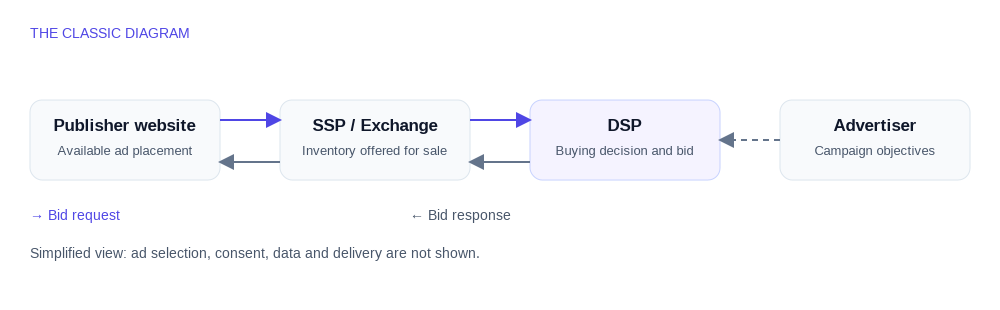
Bid request
A bid request describes an advertising opportunity. It may contain the format, environment, context, a floor price and permitted audience signals.
Bid response
The DSP’s response contains a purchase offer and the elements needed for delivery. The DSP may also choose not to bid, known as a no-bid.
But this is the simplified version. It says almost nothing about collecting bids, managing permissions, intermediaries, selecting data or loading the creative.
Programmatic, RTB and deals: what is the difference?
RTB (real-time bidding) means buying through real-time auctions. It is one form of programmatic buying, but programmatic is not limited to RTB.
On smaller screens, scroll the table horizontally.
| Buying method | Price and access | Reserved volume? | Which deal is needed? |
|---|---|---|---|
| Open auction | Auctions open to buyers eligible on the platform. | No. | No Deal ID is required to buy directly in the open auction.A curator may select open-auction inventory and offer it through its own Deal ID: the buyer then activates a curated deal. |
| Private auction | Auctions restricted to selected buyers, generally with a negotiated floor price. | Generally not. | Yes: an SSP deal or curated deal, depending on the platform and setup.Check authorised buyers and the auction rules. |
| Preferred deal | Preferential access at an agreed price; the buyer may accept or pass on the opportunity. | No. | Yes: an SSP deal or curated deal compatible with these terms.A fixed-price curated deal is not automatically a preferred deal: preferential access must also actually apply. |
| Programmatic guaranteed | A negotiated price and delivery commitment for inventory or volume. | Yes: reservation and delivery management. | Yes: a seller-side PG deal, through an SSP or a platform connected to the ad server controlling the inventory.Integration with a third-party ad server may be suitable. A standard SSP or curated deal accompanied by a volume promise does not, on its own, create a technical reservation. |
Commercially guaranteed or technically guaranteed? A volume promise on an unreserved deal may constitute a commercial commitment without being programmatic guaranteed in the technical sense. This is what we call “pseudo-guaranteed” here: priority inventory reservation and delivery management have not been established. The decisive factor is the delivery configuration, not the product’s name or whether the SSP and ad server belong to the same company.
References: Programmatic Direct in Google Ad Manager and PG with delivery managed in a third-party ad server at Microsoft Monetize.
A Deal ID identifies an agreement or inventory selection within the platforms. By itself, it is not proof of quality, a fixed price or guaranteed volume. A curated deal adds a selection and potentially data or quality rules; its buying terms depend on its configuration.
In practice, the boundaries overlap
A publisher may use a DSP to sell a managed service. An agency may open a curation seat on the SSP side. A historically sell-side platform may offer a direct buying interface. The technology used is therefore not enough to determine the role of the company operating it.
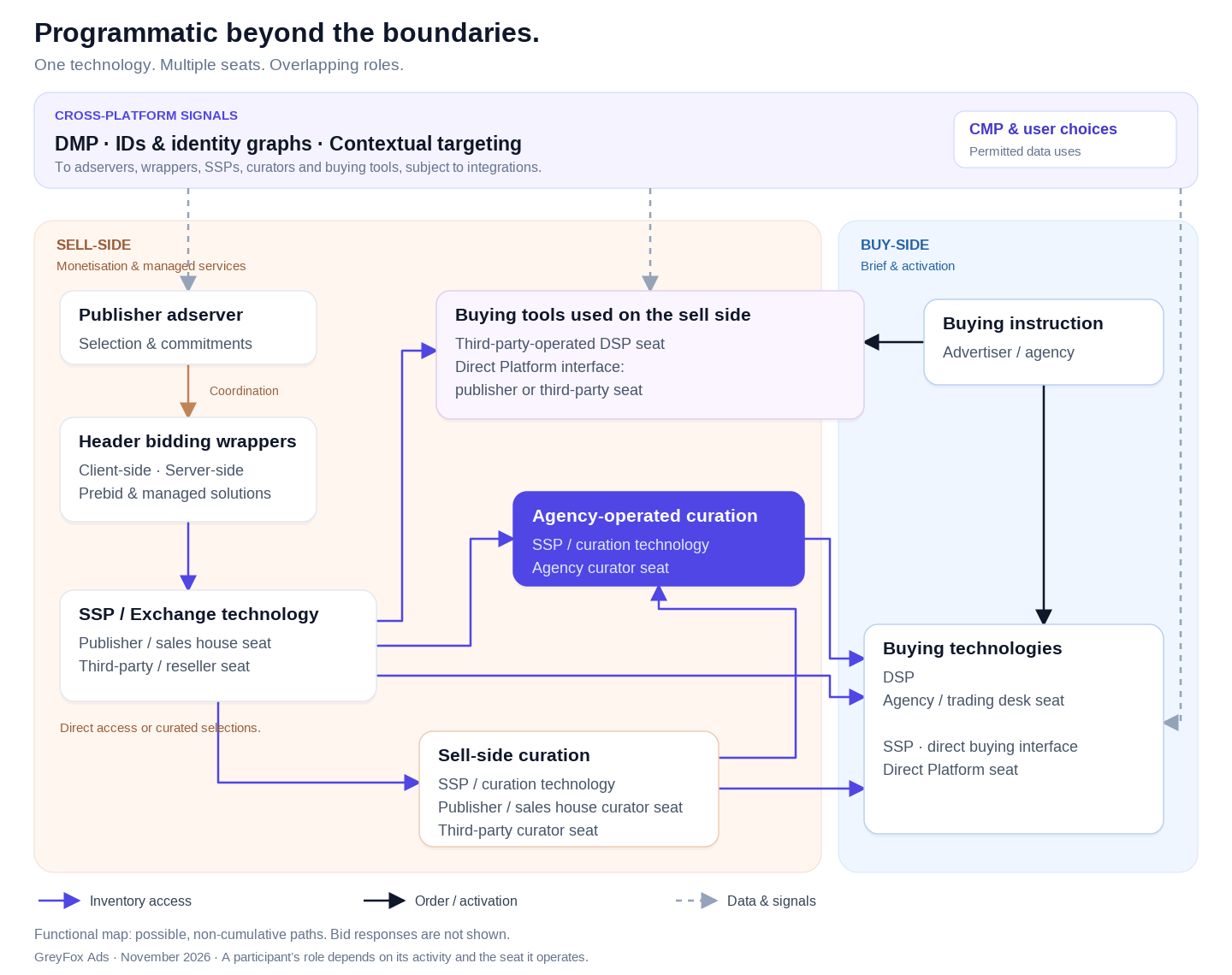
Three ways to read the diagram
- Inventory access paths connect publisher tools, seller accounts and buying tools. The buyer may access an SSP, a curated selection or a service operated by an intermediary.
- Buying instructions come from the advertiser or agency and are entrusted to the chosen operator. A DSP seat or direct buying interface may be operated by an agency, a publisher or a third party.
- Cross-platform signals feed compatible platforms: DMPs, identifiers, identity graphs and contextual targeting. Choices passed by the CMP govern the relevant uses.
This is not a network-call diagram. The ad server–wrapper link represents coordination, not a universal sequence in which the ad server always triggers Prebid. Similarly, curation may apply rules within a platform without adding a standalone server to every auction. Bid requests and bid responses travel over the technical connections actually enabled; creative delivery happens afterwards.
To understand the shift of some decisions towards sell-side platforms, read our analysis of sell-side decisioning and its limitations.
Publisher-side technologies and participants
The client-side header bidding wrapper
A wrapper coordinates calls to multiple demand partners, collects their responses within a defined time limit and prepares them to compete. Prebid.js is an open-source library executed in the browser. The wrapper orchestrates calls; it is distinct from the SSPs it queries.
A publisher can deploy Prebid.js itself or use a custom wrapper and management tools built around Prebid. These services add, among other things, a configuration interface, monitoring, testing and technical support.
- Hubvisor provides a wrapper and monetisation management suite based on open standards such as Prebid.
- Pubstack enables management of a monetisation configuration and its header bidding partners, both browser-side and server-side.
- Nexx360 can connect to an existing Prebid.js setup through an adapter and offers several integration methods for its server-side demand.
Pay attention to scope: these services are not all simply client-side variants of Prebid.js. Xandr PSP, now Microsoft Prebid Server Premium, is a server-side solution, discussed below.
These combinations can also multiply the paths: our article on header bidding “power strips” explains how one wrapper or partner can hide others behind it.
Server-side auctions
Some calls take place between servers, moving the processing load out of the browser. Results nevertheless depend on the integration, timeouts, available signals and enabled partners.
- Prebid Server : open-source infrastructure hosted by the publisher or a service provider.
- Microsoft Prebid Server Premium (PSP, formerly Xandr) : a managed solution based on Prebid Server and integrated with Microsoft Monetize.
- Nexx360 : a server-side header bidding solution accessible, notably, through a Prebid adapter or direct integration.
- Amazon Transparent Ad Marketplace (TAM) : a server-to-server marketplace solution with its own integration.
- Google Open Bidding : a Google Ad Manager feature that puts demand partners in competition through server-to-server connections.
Client-side and server-side can coexist. The choice should be assessed by net revenue, latency, demand coverage and user experience, not merely the number of connected partners.
The publisher ad server
The ad server organises delivery across placements: directly sold campaigns, priorities, commitments and programmatic demand. Google Ad Manager is one example. This ad-serving function should be distinguished from that of an advertising marketplace, even when the same group provides both.
SSP, exchange and seller account: three distinct concepts
An SSP helps sellers market and optimise their inventory. Anad exchange is the marketplace where buying and selling offers meet. These functions are often combined within the same platforms.
An SSP seat, or seller account, is the account operated by a publisher, sales house or intermediary on the platform. The technology’s name is therefore not enough to identify who is actually selling the impression. The proliferation of SSP seats and resellers makes this distinction essential.
Examples of providers: Equativ, Magnite, PubMatic, Index Exchange, Criteo and Google. Each platform’s offering and scope differ.
The useful question: “Which seller account is used, and who operates it?” Buying through a familiar SSP does not guarantee a direct path to the publisher. The same inventory may be offered by multiple resellers along multiple routes.
For more detail: our analysis of reseller bid requests (read the findings alongside the analysis’s scope).
Buyer-side technologies and participants
DSP, DSP seat and trading desk
A DSP (demand-side platform) is a buying technology. It enables campaign configuration, opportunity assessment, bidding, budget management and delivery optimisation.
The DSP seat is the account used within this technology. The trading desk is the team or organisation operating the buying: an agency, an independent provider or an advertiser’s in-house team.
The platform is not the operator. Two teams using the same DSP can achieve very different results depending on their strategy, inventory, data and optimisation work. DSP algorithms optimise towards the objectives and constraints they are given ; that does not remove the need to question them.
Examples: Display & Video 360, The Trade Desk, Amazon DSP, Adform and StackAdapt. Available inventory, tools and commercial terms vary.
Historical context: Microsoft announced its transition away from media buying through Microsoft Invest, formerly Xandr Invest, from 28 February 2026. This DSP should not be confused with Microsoft Curate or Monetize. Official announcement.
The advertiser ad server and creative tools
The advertiser ad server centralises creative delivery and tracking, depending on formats and integrations. It can help manage versions and consolidate measurement. It does not replace the DSP: one organises creatives and their tracking, while the other manages buying. Campaign Manager 360 illustrates this category.
Dynamic creative technologies can adapt a message using permitted signals. Files may also be hosted through a CDN, without every campaign using a separate third-party ad server.
Consent, data, identity and measurement
The CMP: collecting and passing on choices
A CMP (consent management platform) displays information and choices to users, records their preferences and passes signals to the relevant partners. Installing it is not enough: technologies must actually respect the choices communicated.
For publishers, these choices also affect revenue and content access models, as we explain in our analysis of consent walls and the “consent or pay” model.
Examples of solutions: Didomi, Commanders Act, Sirdata, Axeptio, OneTrust and SFBX. This selection is neither exhaustive nor a market-share ranking.
The CNIL distinguishes trackers requiring consent from those that may be exempt under certain conditions. Read the rules on cookies and trackers.
The DMP: organising and activating audiences
A DMP (data management platform) gathers and organises data to build segments that can be activated. Depending on its connections, it may send those segments to an ad server, SSP, curation platform or DSP. Not every connection is available by default.
Data may come from a direct relationship (first-party), a partnership with a data owner (second-party) or third-party providers. At GreyFox Ads, we use the expression “1.5-party data” to describe audiences consuming content about a brand or its products on third-party websites. This descriptive concept is not a standardised category; activation depends on agreements with data owners and the applicable permissions.
Identifier providers
Advertising identifiers help compatible platforms recognise or match signals for certain uses: audience activation, measurement or frequency management. ID5, Utiq and LiveRamp’s RampID illustrate different approaches. Their coverage, collection methods and usage conditions are not interchangeable.
Identity graphs
An identity graph organises relationships between identifiers or devices. Matching can be deterministic or probabilistic, with varying confidence levels. An identifier provider may also operate a graph: they are not necessarily two separate providers.
Cookieless does not mean consentless. An alternative identifier is not a way to bypass user choices. Conversely, contextual targeting may select an ad based on the content being viewed without identifying the person; any measurement trackers still need to be considered separately.
Read: the challenges of buying cookieless impressions and the CNIL’s definition of contextual advertising.
Verification and measurement
Tools such as Integral Ad Science or DoubleVerify offer ad verification capabilities: fraud, viewability, brand safety and contextual suitability, depending on the product. Signals may be used before buying or for measurement after delivery.
Attention, viewability and video completion are different measures. Our analyses of the limitations of viewability as a KPI and advertising attention on the open web explain this distinction. A completed video has not necessarily been watched attentively. The methodology, measurable scope and denominator of each metric need to be specified.
Where does programmatic curation fit in?
Curation involves selecting and organising inventory, data and buying rules so they can be activated as deals. It may cover publishers, formats, supply paths, audiences or quality criteria.
The curation platform
This is the technology used to build and distribute deals. Examples: Maestro by Equativ and Microsoft Curate, formerly known as Xandr Curate.
The curator or operator
This is the company using a seat on the platform to create an offering: a sales house, agency, data owner or specialist. It defines its selection and remuneration.
Value does not come from merely having a curator seat. It comes from the work done: inventory quality, useful data, control over supply paths, results monitoring and fee transparency.
It should therefore be possible to explain what is selected, what is excluded, who sells the inventory and how the service is paid for. Stacking several curation layers does not guarantee an improvement.
For more detail: curation and curator seats ; the limitations of meta-curation.
At GreyFox Ads, we use curation to prepare a selection of inventory and rules that can be activated through the buyer’s DSP. The Master Deal brings that preparation together in a Deal ID; our consultancy service also helps structure curation operations.
What are the benefits, costs and risks?
What automation brings
Accessing multiple inventories, adjusting bids, managing budgets and adapting campaigns to available opportunities. It speeds up the execution of a strategy.
What it does not guarantee
Context quality, freedom from fraud, a direct supply path, comprehensive measurement or commercial effectiveness. These require choices and checks.
Understanding the price actually paid
The CPM is the cost per thousand impressions. The total cost may include media and various fees: platform, data, verification, curation and buying services. Depending on contracts, these are included in the displayed price or invoiced separately. This is one of the issues in financial transparency across the programmatic chain.
A purely illustrative example: 100,000 impressions at a €6 CPM cost €600. If a €0.50 CPM data charge is added on the same impressions, the total becomes €650 before any other fees. Fees already included must not be added a second time.
Checking the supply chain
ads.txt allows publishers to declare authorised sellers. sellers.json and the SupplyChain Object help identify sellers and intermediaries. These mechanisms complement each other; they are not a certification of editorial quality.
SPO (supply path optimisation) means evaluating and selecting paths to inventory. The goal is to retain useful routes based on cost, transparency, quality and access to demand. Our article on the real challenges of SPO explains why the placement should be assessed before comparing its access paths.
Measuring what matters for the campaign
- Awareness: reach, frequency, viewability, completion and attention where measurable.
- Traffic or acquisition: qualified visits, conversions, acquisition cost and the quality of the attribution setup.
- Media quality: domains, placements, invalid traffic, sensitive contexts and inventory designed primarily to maximise ad volumes (MFA).
The race for the lowest CPM can hide poor-quality exposure. Conversely, a high CPM is not proof of effectiveness. Compare equivalent scopes, fees and measurement methods.
How do you choose programmatic partners?
Yes, the ecosystem can quickly become a real headache. But the aim is not to know every acronym: it is to know which questions to ask.
- Who actually operates the buying or selling? Ask for a distinction between the technology provider, the account used and the responsible team.
- Which inventory will your ads run on? Which domains, apps, formats, placements and exclusions?
- Through which paths? Which direct sellers or intermediaries, and what visibility into their identity?
- Which signals are activated? Data, contextual signals, identifiers, consent and coverage actually available.
- What does each component cost? Clarify included and additional fees, and how the service is remunerated.
- How will results be assessed? Define metrics, their denominators and measurement limitations before launch.
To turn these questions into practical checks, see our method for auditing your own programmatic buying.
Fewer connections. More control.
Have a brief to activate, a curation offering to build or a setup to clarify? GreyFox Ads helps you make the technical choices and put them into practice.
Frequently asked questions
What is the difference between programmatic and RTB?
Programmatic automates buying and selling. RTB means real-time auctions. Programmatic buying can also take place at an agreed price, with or without guaranteed volume.
Do you need a DMP for programmatic advertising?
No. A campaign can use context, an inventory selection or signals already available within its platforms. A DMP is useful only if it meets a data need and has the necessary integrations.
Does a Deal ID guarantee premium inventory?
No. It identifies a configuration or an agreement. Quality depends on the inventory, rules, sellers and checks associated with the deal.
Can you buy without third-party cookies?
Yes, notably through context and inventory selection. Other approaches may use compatible identifiers, depending on availability and applicable permissions. Without third-party cookies does not mean without consent.
What budget should you plan for?
There is no universal minimum. DSP access, provider terms, format, duration and objectives determine an appropriate budget. It should generate enough observations to assess the campaign.
Sources and further reading
This guide provides an educational, operational perspective on the ecosystem. The brands mentioned are examples, not a ranking or an exhaustive list. Features and integrations should be confirmed with each provider.
- CNIL — definition of programmatic advertising and contextual advertising.
- Prebid — introduction to header bidding and Prebid Server.
- Google Ad Manager — how Open Bidding works.
- Amazon Publisher Services — TAM.
- IAB Tech Lab — sellers.json and SupplyChain Object.
- Equativ — introduction to Maestro and Microsoft Curate.
Guide written by Max Legrand, founder of GreyFox Ads. Last updated: 16 November 2026. Learn more about GreyFox Ads.