What happened when we tried to buy across all three Open Web environments?
The other day, something strange happened with a Curated Deal we'd sent to a buyer.
To boost genuine reach, we'd deployed three strategies within the same deal:
| Inventory group | Share of sessions in our working split | Why it matters |
|---|---|---|
| 🚫🆔 No consent for certain advertising trackers | ~20% | Requires advertising approaches that respect the user's permissions |
| 🚫🍪 Cookieless, with eligible consent | ~22% | Traditional third-party cookie-based buying is unavailable |
| ✅🍪 Cookie-friendly | ~58% | The familiar identifier-based buying environment |
But when we pulled the stats... it was a cold shower 🥶
More than 90% of the spend was concentrated on the last group 🤯 — even though the whole point was to cover the other environments too.
(The 20/22/58 split is a working segmentation used in our French-market analysis, not an independently audited census. The >90% spend figure is an observation from this particular deal, not a market average. Sessions and purchased impressions have different denominators.) The source post repeats “Consentless” for the 22% category; here we clarify it as cookieless with consent, consistent with our three-environment explanation.
So we started our little investigation 🕵️
What's the difference between cookieless and consentless advertising?
Cookieless means an impression cannot use the usual third-party cookie for identification, even if relevant consent has been given (Safari and Firefox are familiar examples). Consentless is shorthand here for inventory where the user has not consented to particular advertising-related storage, access or personalisation activities. They are not the same condition.
That distinction matters on the buy side: cookie absence is a technical constraint; missing consent can be a legal and platform-permission constraint. Neither automatically forbids all advertising. In France, contextual advertising may be possible without certain trackers, but tracking for capping or measurement can separately require consent. See the CNIL's cookies and trackers guidance, and our article on why publishers are exploring consent walls.
Problem no. 1: how can SSP throttling hold back cookieless inventory? 🌪️
By default, the SSP was sending very few Safari or no-consent bid requests (BRs) — around 10% in the traffic flow we examined. So even before the DSP made a buying decision, much of the supply we wanted to activate was barely reaching it.
Our interpretation? The SSP's traffic-shaping logic was limiting requests that it expected the DSP to buy rarely, to avoid wasting infrastructure capacity 🚫💸 (the exact algorithm and reasons can differ by SSP, and this was not a controlled test of its internal decision rules).
Bid-request throttling is the selective reduction of auction requests sent by a supply-side platform to a bidder, often to manage traffic volume and efficiency. It is not identical to the DSP itself rejecting an impression: one happens before the opportunity reaches the buyer, the other after.
The good news? Some throttling algorithms respond to demand. When a DSP starts buying the inventory, its SSP connection may receive many more requests. The throttler eases off; suddenly there are MANY more BRs. 🔓
(The responsiveness is our experience with this setup, not a guarantee of how every SSP optimises traffic. Technical bidder configurations can also affect what the SSP sends; for example, Equativ documents DSP-specific bid-request handling.)
Problem no. 2: why does a DSP prefer cookie-friendly impressions? 🍫
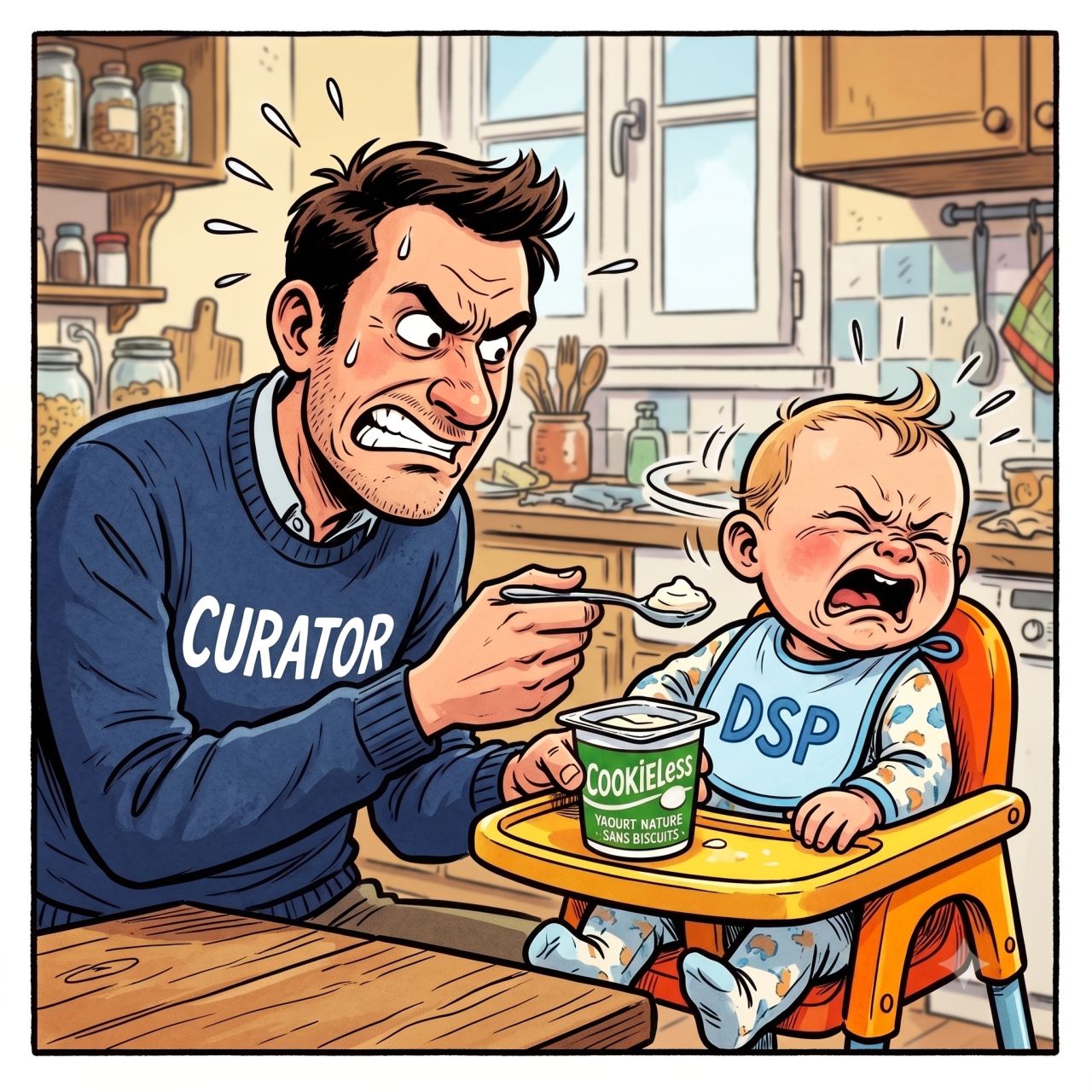
If you've got a young child handy, try this experiment:
- At mealtime, put two yoghurts in front of them: a plain organic yoghurt and a chocolate yoghurt.
- Then try to get them to eat the organic one. Good luck... 🥵
Well, it's exactly the same problem with DSPs (the baby) and cookieless inventory (the organic yoghurt).
Why would a DSP make life difficult for itself by investing in impressions that are awkward for targeting, frequency capping and measurement, when there's still plenty of cookie-friendly inventory on Chrome?
And after all, IT'S the one deciding which impressions to buy 💪
This isn't an accusation that a DSP literally refuses every cookieless bid. It's a buying-efficiency problem: algorithms and line-item settings tend to prioritise opportunities they can activate and optimise against familiar signals. Certain targeting or tracking settings may also make a non-personalised impression ineligible. Google's DV360 documentation explicitly describes separate targeting requirements for non-personalised ad inventory.
| Stage | Observed bottleneck | What to check |
|---|---|---|
| 1. SSP → DSP | Few Safari or no-consent requests transmitted | Deal eligibility, traffic-shaping settings and requests actually sent |
| 2. DSP evaluation | Available impressions receive few bids or little spend | Targeting, privacy eligibility, creative restrictions, bid strategy and budget |
| 3. Delivery | Deals remain underfunded despite eligibility | Line-item allocation, pacing, bid competitiveness and quality controls |
Without comparing all three stages, teams risk treating every low-spend deal as a supply problem when some of the constraints actually sit on the buying side.
How do you get a DSP to give cookieless inventory a fair chance? 🍶🥄👶
So how on earth do we solve the problem?! 🤷
The good news is that there IS a way to encourage the DSP to “eat its organic yoghurt” 😉
- Create a new deal dedicated entirely to eligible cookieless inventory in the Curator / SSP. Define clearly which inventory belongs in the deal, and retain the necessary quality and privacy safeguards.
- Ask the buyer to isolate the new Deal ID in a specific DSP line item, with a dedicated budget — and, above all, NO additional DSP-side targeting! (Meaning: do not layer on audience filters that would exclude this supply; retain the mandatory privacy, creative and brand-safety controls.)
Now the DSP can't simply spend the entire campaign budget on the easy, cookie-enabled group. The dedicated allocation gives cookieless supply a proper shot at delivery. If it wants to spend that budget, it has to look at the deal's inventory. 💵💵
That was the idea behind our deliberately provocative “force the DSP” formulation. Of course, a separate budget doesn't force a DSP to bid on an ineligible impression, override its algorithm or bypass consent. In some setups the line may underdeliver. The test is whether it starts to buy eligible supply and whether the SSP responds with more bid requests.
Which is why dedicated Consentless / Cookieless strategies can be so useful for increasing genuine reach 👍 (provided that targeting and measurement are legally permitted, and that incremental reach is actually demonstrated).
Elementary, my dear Watson 🧐
Curious about the wider supply mechanics? Our guide explains how Curator Seats and curated Deal IDs work.
How can Media Traders tell whether the cookieless deal is really working?
A dedicated budget is a means to an end, not the result itself. We would look at four concrete questions:
- Supply: do more eligible Safari and cookieless bid requests reach the DSP after activation?
- Bidding: are the bid participation rate, wins and spend increasing on the dedicated line item?
- Delivery and quality: does the deal deliver with suitable placements, acceptable CPMs and a reasonable pacing profile?
- Reach: does it add audiences not reached by the existing cookie-friendly strategy? (Where user-level deduplication is unavailable or inappropriate, report an estimate or limitation rather than claiming precise incremental reach.)
Google's deal troubleshooting documentation describes how buyers can investigate targeting and pre-bid filters. The same questions are relevant to any DSP with comparable diagnostics, though reports and permissions differ by platform.
A necessary privacy nuance: “no extra DSP-side audience targeting” is not permission for unauthorised personalisation or tracking. Under French and EU rules, the relevant consent signals and legal basis still determine which processing is permitted. See DV360's GDPR-specific buying rules and the CNIL guidance above.
GreyFox Ads: quality French Open Web inventory, beyond the usual cookies
At GreyFox Ads, we're convinced that quality French Open Web inventory delivers real effectiveness for advertisers.
We're the small French programmatic sales house that likes complicated buying problems... particularly when we can make them simpler for Media Traders. 🦊
We offer:
- To Media Traders: a Swiss Army knife Master_Deal_ID, designed to solve A LOT of the programmatic ecosystem's problems 👑 — from supply quality and suitable targeting to transparent costs.
- To Programmatic Sales Houses: consulting assignments on programmatic and Curation 💡.
Want to work with a quality partner? 📧 Contact GreyFox Ads!
Sources and further reading
- Original GreyFox Ads post — source of the campaign anecdote, the 20/22/58 segmentation and the yoghurt analogy.
- GreyFox Ads — The three faces of the French Open Web — clarifies the working session shares.
- Google Display & Video 360 — About non-personalised ads — what its buying setup permits and restricts.
- Google Display & Video 360 — GDPR and ad-inventory eligibility.
- Google Display & Video 360 — Deal troubleshooting.
- Equativ — Connecting bidders to its SSP.
- CNIL — Cookies and trackers FAQ (French).
Editorial note: the case study is GreyFox Ads' own reported experience. We have not published the underlying campaign logs, the exact SSP algorithm or independently audited market estimates. The source post's 22% inventory group was labelled “Consentless” a second time; the amended English terminology reflects the author's separate analysis of consented cookieless sessions. The original post's publication date was not supplied; the date in the header is the English HTML edition's update date.