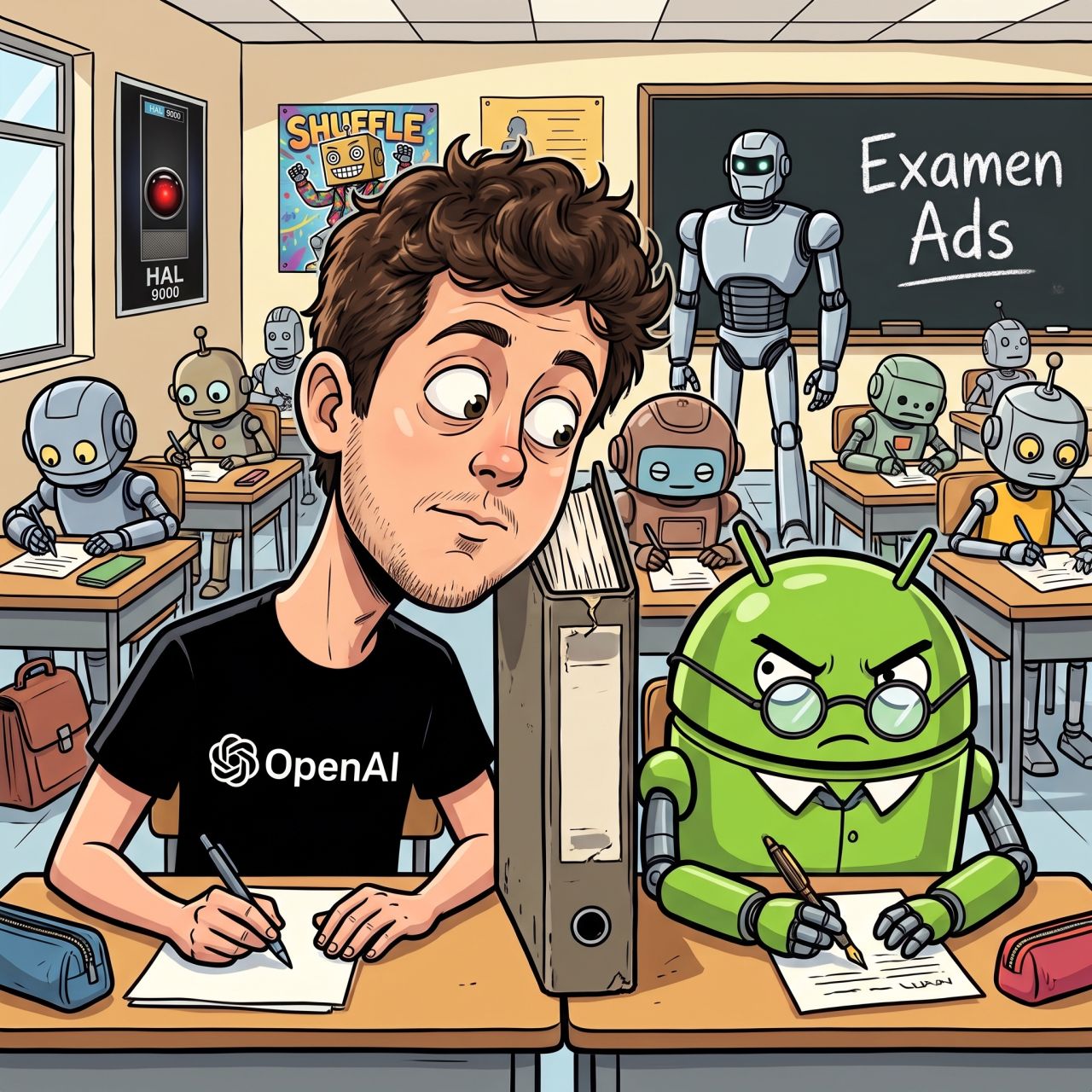
OpenAI has a little problem. 🤏
Its advertising offering for advertisers isn't up to scratch. 😮
The platform offers image + text ads:
- 🤨 Outside the chatbot's answer
- 😤 Not necessarily related to the subject of the conversation (from the advertiser's point of view)
- 😡 With reports that don't detail the contexts in which ads appeared
It's an offering that's very easy for advertisers to test. 😀
But it's going to struggle to persuade advertisers to invest billions... 💸💸😒
This is the author's assessment of the advertising offer in late 2026. OpenAI describes context- and intent-based ad matching, including advertiser-supplied context hints; those hints are not exact-match keyword controls. Its documented reports contain aggregated metrics, rather than the underlying conversations (OpenAI Ads Manager documentation).
What do advertisers REALLY want from AI advertising?
What advertisers REALLY want is, above all:
- 🎯 To be RECOMMENDED in AI answers to carefully selected questions.
- 💵 To SELL their products, either directly in the app or via a redirect.
- 📊 To measure and report at a granular level so they can optimise.
Those are the outcomes the author sees as most valuable for marketers. But there's an important difference between an independent organic recommendation and a labelled sponsored placement. The first should not be sold as the second (or vice versa).
ChatGPT's published policy currently keeps advertisements separate from its independent responses. A future sponsored-answer format would be a hypothetical new model, and it would need clear labelling rather than passing paid content off as an organic recommendation (OpenAI advertising principles).
Why might advertisers favour “sponsored GEO” alternatives?
Faced with such a weak value proposition from GPT Ads today, advertisers will probably favour smarter “sponsored GEO” offerings (e.g. SMALK, Prisma Media's “Content for LLM”, etc.), which aim to help advertisers:
- Get mentioned directly in AI answers
- In response to the specific questions they're interested in
- While paying publishers along the way 😉
Here in France, this model is being explored by companies that combine Generative Engine Optimisation (GEO), contextual advertising on publisher sites and measurement of brand mentions in AI answers.
| Approach | What the offer does | What it cannot guarantee |
|---|---|---|
| SMALK | Maps sources used by AI tools, activates contextual ads on participating publisher pages and supports AI-platform advertising. | Buying a publisher placement does not guarantee an organic recommendation in every AI answer. |
| Prisma Media — Content for LLM | Combines GEO audit, editorial content creation and distribution, followed by monitoring of brand visibility and citations. | Visibility and citations vary across queries, engines and time; they are not the same as buying a guaranteed answer placement. |
These are public descriptions from the providers, not independent performance validations or evidence that ChatGPT sells its organic recommendations. The distinction between sponsored content, AI citations and native platform ads matters for both measurement and transparency.
What if ChatGPT Ads simply copied Google's advertising playbook? 👀✍️
And yet OpenAI has an extremely simple solution it could implement:
Copy Google's entire Ads system! 👀✍️
In other words:
🎯 Let buyers choose their queries
Let advertisers define the keywords or questions on which they want to appear, with the familiar exact / phrase / broad precision settings. Conversational queries would still need a meaningful interpretation of intent rather than treating every prompt as a short Google search.
✅ Truly native — and clearly sponsored
Offer ads tailored to the answer experience, such as sponsored products or short contextual sponsored recommendations. In the author's ideal vision they sit where the user makes a decision, but paid content must remain explicitly labelled, not secretly blended into an organic answer.
💯 Reward quality, not just bids
Define a quality signal for every [advertiser / product / query] combination, so the most relevant and legitimate advertisers can obtain better placement and potentially lower costs. (Google's visible Quality Score is a diagnostic metric; its auction actually uses quality signals in Ad Rank.)
📊 Make optimisation measurable
Offer highly granular reporting on placement categories, query-intent segments, outcomes and conversions — precise enough for Media Traders to optimise, while protecting the privacy of individual conversations.
These are four proposals, not four features that advertisers can necessarily buy on ChatGPT Ads today. For the Google Search references, see Google's descriptions of keyword match types, Ad Rank and Quality Score.
ChatGPT Ads in 2026 vs the Google-inspired model proposed by GreyFox Ads
| Question for the buyer | Documented ChatGPT Ads offer (Nov 2026) | GreyFox Ads proposal |
|---|---|---|
| Where does my ad appear? | In a distinct sponsored unit beneath a response. | Relevant, clearly labelled sponsored products or contextual formats at the decision point. |
| Can I select an exact prompt? | Context hints guide matching; not a guarantee of delivery on a given prompt. | Advertiser-defined queries with exact, phrase or broad controls. |
| How is it ranked? | OpenAI says it considers expected relevance, outcomes and advertiser bids. | An explicit advertiser/product/query quality framework. |
| Can I analyse placements? | Aggregate impressions, clicks, costs and conversion reporting; conversation-level placement data is not provided. | More actionable query-intent segments and conversion insights, with privacy safeguards. |
This table reflects publicly documented product information available at the time of this English edition. Platform features may change. The “GreyFox Ads proposal” column is editorial opinion, not a product roadmap.
Could ChatGPT Ads become a serious competitor for Google Search advertising budgets?
If ChatGPT Ads implements all this — and we hope for their sake it's in the pipeline — then, for the first time since its creation, Google will face a serious competitor for SEA budgets (excluding Retail Search). 💪
SEA (Search Engine Advertising) has historically allowed advertisers to translate a precise intent into a measurable commercial action. The author's argument is that conversational AI could offer a competing proposition if it combines the same degree of buyer control with the new experience of asking an assistant for advice.
That would require a careful balance: make sponsored opportunities more commercially effective without compromising the independence of the assistant's answers. The prediction remains an opinion, not a confirmed market outcome.
For related GreyFox Ads analysis, see our hands-on assessment of ChatGPT Ads targeting and reporting, why Zero Click Search changes advertiser objectives, and the economic challenge AI answers pose for publishers.
Sources, original post and further reading
- Original GreyFox Ads LinkedIn post (author's opinion).
- Original French-language article.
- OpenAI: Ads in ChatGPT — format, selection, reporting and measurement.
- OpenAI: advertising principles and answer independence.
- Google Ads: keyword match types; Ad Rank; Quality Score.
- SMALK: publisher-based AI advertising; Prisma Media: Content for LLM.
The source post did not specify a verified publication date. This edition is a dated editorial update. All future product suggestions are the author's proposals; there is no claim of an OpenAI announcement or of paid influence over independent ChatGPT recommendations.